



Keine Kunst ist es, alt zu werden; Kunst ist, es zu ertragen
It is no art to grow old; the art is to weather it
Maximen und Reflexionen, 1833 by Johann Wolfgang von Goethe
Warm-up
Billionaire Mr. Bryan Johnson embodies "healthmaxxing," the viral wellness trend. He relies on dozens of daily supplements, blood plasma transfusions, and a plethora of tests to maximize his physical performance, longevity, and wellness [1]. Healthmaxxers do not get deterred by minor health hiccups at age 50 on their way to at least 150, when cell mutation will kill them no matter what [2, 3]. His extraordinary efforts to prolong his life might have temporarily backfired as Mr. Johnson now justifiably needs to take B12 supplements to aid recovery from autoimmune gastritis. However, supplements, which are appropriate for addressing deficiencies, can increase mortality in both ill and healthy people [4-10]. While estimators put my biological age at 57, even though I am chronologically 71, my personal goal is a bit more modest and realistic. I aim to fade out around age 80 to 85 instead of reaching 150, banking on a much more mundane device than supplements, megadosing, or blood transfusions: physical activity. Walking is not just a daily routine but one of the many forms of physical activity. But how can such a seemingly simple and automatic activity provide life-extending health benefits? Most likely through its speed.
Training session
Our walking (gait) is unique and captures our personality, mental state, physiology, and biomechanics. According to my latest count, walking can take on at least 32 different forms. After a few steps, we can recognize several types of gaits, including antalgic (limping), ataxic (unsteady), catwalk, festinating (an inability to stop), tabetic (foot slapping), and Parkinsonian shuffling. We can also identify characteristics influenced by habit, emotion, or demographics, such as toe-out, running, sad, happy, male, and female gait. (Fig. 1).
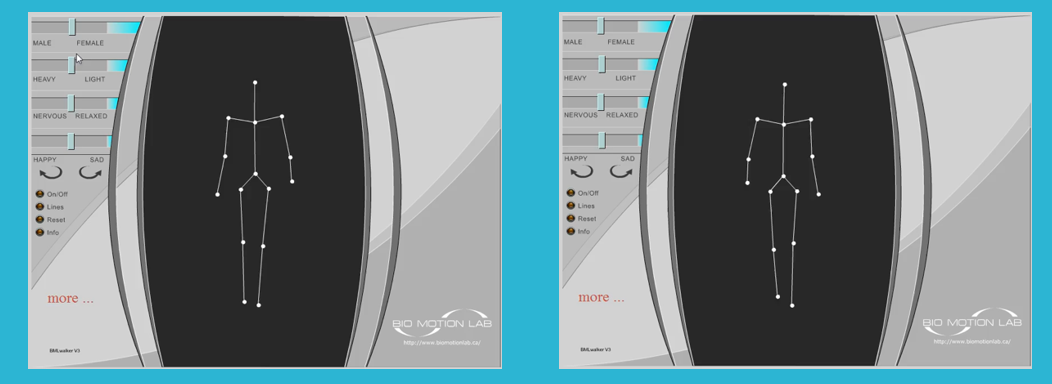
Fig. 1. Illustrations of male vs. female walking (left) and happy vs. sad walking (right). Click on the video on the left to play. Notice how walking style shifts from neutral at start of the video to male and female type of walking. By clicking on the right video, notice how walking expresses sadness first and then happiness.
Recognizing the medical, physiological, cognitive, and health-related importance of maintaining walking speed in old age, some researchers consider habitual walking speed as the sixth vital sign [11]. Even healthy aging is accompanied by subclinical impairments in muscle, cardiovascular, and cognitive function. These barely noticeable dysfunctions accumulate and manifest through slowed walking. Indeed, habitual walking speed slows by 16 % per decade after age 60. Age- and sex-referenced reductions in walking speed in late midlife predict many conditions later in life, including daily function, mobility, independence, falls, fear of falls, fractures, health, mental health, cognitive function, post-acute transition to the community, adverse clinical events, hospitalization, institutionalization, mortality, and survival [12]. Fig. 2 illustrates the remarkable effects of walking speed on survival: walking 0.5 m/s faster at age 75 can mean seven years longer life in men after adjustments for covariates [13].
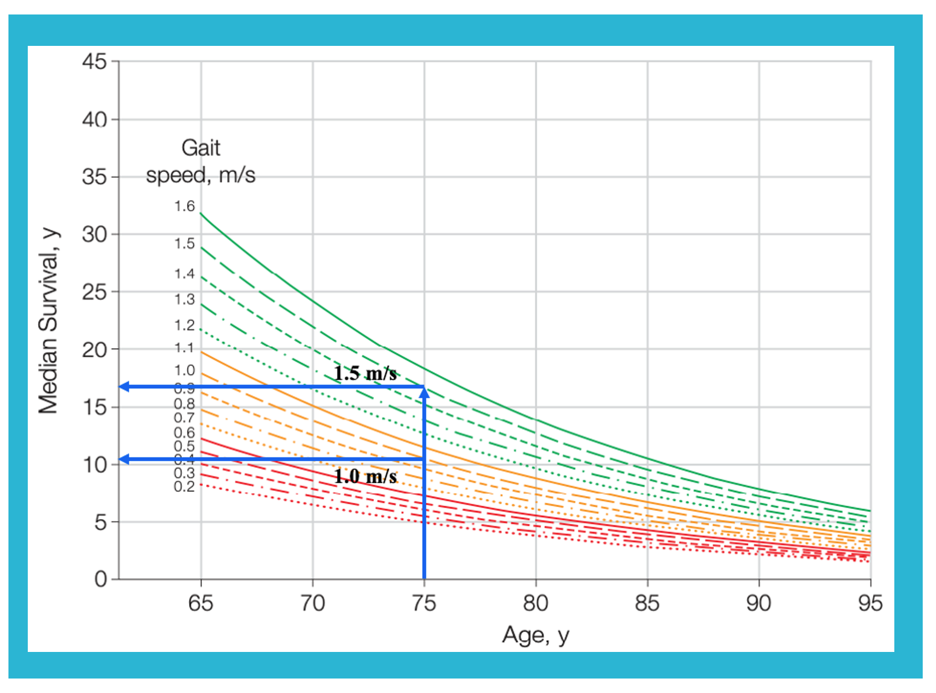
Fig. 2. Effects of walking speed on survival. The inset curves denote survival at habitual walking speeds between 0.2 to 1.6 m/s. The example illustrates if one man walks at 1.0 m/s and another man walks at 1.5 m/s, after adjusting for height, sex, race, body mass index, smoking, history systolic blood pressure, diseases, prior hospitalization, and self-reported health, the one with the faster walking speed will live approximately seven years longer solely due to the faster walking speed. Data are from nine cohorts of 34,485 community-dwelling adults age over 65 re-tested 6 to 21 years after a baseline test of walking speed. Modified after ref. 13.
Brain health is associated with walking speed. This is because the same brain areas that supervise step length, cadence, and walking speed also underlie cognitive control, decision making, attention, executive function, word comprehension, vision, anticipation, and memory. The number of neurons making up the outer brain layer (measured via cortical thickness in several areas) and the quality of white matter paths interconnecting these areas are associated with step length, cadence, and walking speed [14, 15]. These associations form the basis for predicting future cognitive decline from walking speed measured in early life [16-18]. While walking, we avoid obstacles, talk to people, perform calculations or think about upcoming appointments. Humans cannot simultaneously perform two tasks that require attention. With respect to walking, most often we prioritize the cognitive task over the motor task, and our walking speed slows. Dementia clinics now add a cognitive or a motor task to the walking-speed test to improve predictions of future cognitive function [19].
We do not have to train like Olympic champions to maintain or increase our habitual walking speed. But adding some speed to our ambling can do the trick. Fast compared with slow walking acts as a stronger aerobic stressor of carbohydrate metabolism and insulin control; increases the number and size of mitochondria more effectively; raises blood pressure and heart and respiratory rates more steeply; triggers faster endothelial self-renewal; makes our senses and thinking sharper; creates higher joint and muscle loads per step, and demands simultaneous balance, coordination, and timing. Such physiological and biomechanical responses to speed walking accrue health benefits [20].
The simplest training is walking as often and as far as possible. This includes taking the stairs (the best exercise), walking to the bus stop, and parking the car at the far end of the lot. Walking three minutes at a habitual speed followed by three minutes at a faster pace, and repeating this cycle 5–6 times, is a good start to a training program. Including hills is even better. To achieve physiologically meaningful changes in the cardiovascular system and muscles, the human organism needs repeated exposures to training stimuli and some variation in intensity. Therefore, we might want to visit a gym and participate in an individual or group training program. The good news is that, for the uninitiated, speed walking, strength training, or coordination training will all uniformly increase fast walking speed by 0.12 m/s over a matter of weeks [12]. However, to maintain these gains, we must participate in systematic training programs with or without supervision [21].
Cool down
Walking briskly is a natural way of healthmaxxing. Walking is an excellent way to counter the effects of aging and increase healthspan, the number of years lived in relatively good health. Walking has a low injury burden and is enjoyable in small groups. Over time, it can also create the foundation for many other forms of physical activity that are a bit more demanding. And the icing on the cake, walking sparks creativity: Wordsworth composed poetry while walking, Mahler walked for three to four hours for his compositional retreats, Aristotle lectured on the move, Brahms developed musical ideas in ‘rhythmic instability’, and Nietzsche proposed that only thoughts reached by walking have value. Walk to live, live to walk!
References
- Johnson B. Don’t die. Accessed 23 September 2026 at https://www.bryanjohnson.com/
- Efimov E, et al. Somatic mutations impose an entropic upper bound on human lifespan. NPJ Aging. 122026.
- Hashimoto K, et al. CD4 CTLs in supercentenarians. Cell Rep.117728, 2026.
- Bjelakovic MS, et al. Fulleropeptide esters as potential self-assembled antioxidants. Beilstein J Nanotechnol. 6:1065-71, 2015.
- Alpha-Tocopherol BCCPSG. The effect of vitamin E and beta carotene on the incidence of lung cancer and other cancers in male smokers. N Engl J Med. 330:1029-35, 1994.
- Hennekens CH, et al. Lack of effect of long-term supplementation with beta carotene on the incidence of malignant neoplasms and cardiovascular disease. N Engl J Med. 334:1145-9, 1996.
- Miller ER, 3rd, et al. Meta-analysis: high-dosage vitamin E supplementation may increase all-cause mortality. Ann Intern Med. 142:37-46, 2005.
- Lonn E, et al. Effects of long-term vitamin E supplementation on cardiovascular events and cancer: a randomized controlled trial. JAMA. 293:1338-47, 2005.
- Vinceti M, et al. The selenium and vitamin E cancer prevention trial: a secondary, post-intervention analysis on potential excess chronic disease incidence induced by selenium administration. Am J Epidemiol. 2026.
- Klein EA, et al. Vitamin E and the risk of prostate cancer: the Selenium and Vitamin E Cancer Prevention Tria. JAMA. 306:1549-56, 2011.
- Fritz S, et al. White paper: "walking speed: the sixth vital sign". J Geriatr Phys Ther. 32:46-9, 2009.
- Hortobágyi T, et al. Effects of three types of exercise interventions on healthy old adults' gait speed. Sports Med. 45:1627-43, 2015.
- Studenski S, et al. Gait speed and survival in older adults. JAMA. 305:50-8, 2011.
- Verlinden VJ, et al. Tract-specific white matter microstructure and gait in humans. Neurobiol Aging. 43:164-73, 2016.
- de Laat KF, et al. Cortical thickness is associated with gait disturbances in cerebral small vessel disease. Neuroimage. 59:1478-84, 2012.
- Kikkert LHJ, et al. Walking ability to predict future cognitive decline in old adults. Ageing Res Rev. 27:1-14, 2016.
- Skillback T, et al. Slowing gait speed precedes cognitive decline by several years. Alzheimers Dement. 18:1667-76, 2022.
- Buracchio T, et al. The trajectory of gait speed preceding mild cognitive impairment. Arch Neurol. 67:980-6, 2010.
- Bridenbaugh SA, et al. Motor cognitive dual tasking: early detection of gait impairment, fall risk and cognitive decline. Z Gerontol Geriatr. 48:15-21, 2015.
- Wei L, et al. Combinations of stepping intensity and daily step counts against all-cause and cardiovascular disease mortality: insights from a device-based prospective study. Br J Sports Med. 60:1401-8, 2026.
- Brahms CM, et al. The interaction between mobility status and exercise specificity in older adults. Exerc Sport Sci Rev. 49:15-22, 2021.